Dere Test vs MBTI: How 12 Anime Dere Types Map to 16 Personalities
MBTI explains how your mind gathers information and makes decisions, while a dere test maps how your emotional armor and affection style shift around someone you care about.
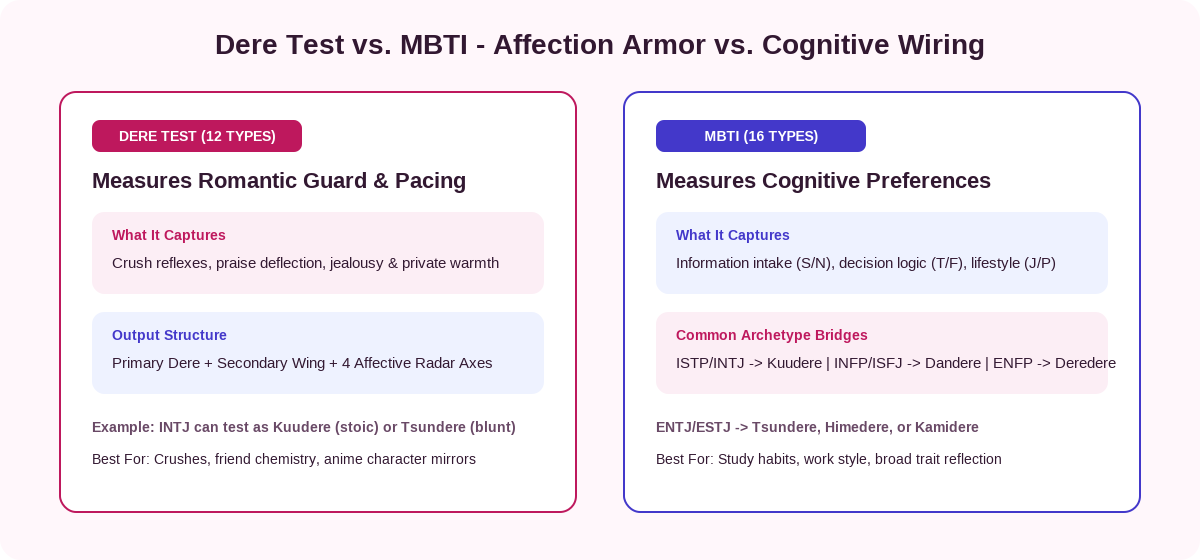
| Dimension | Dere Test (12 Archetypes) | MBTI (16 Personalities) |
|---|---|---|
| Primary Question Answered | How do I guard vulnerability and show affection to crushes or close friends? | How do I process information, evaluate decisions, and organize daily life? |
| Core Scoring Axes | Expressive Warmth, Protective Guard, Attachment Intensity, Social Initiative | Extraversion/Introversion, Sensing/Intuition, Thinking/Feeling, Judging/Perceiving |
| Result Format | Primary Dere + Secondary Wing (or Dual Blend) + 12 percentages + radar | 4-letter type code (such as INTJ, INFP, ENFP, or ISTP) |
| Origin & Scope | Japanese anime & visual novel character tropes (entertainment & reflection) | Jungian cognitive preference typology (work, study, and broad habits) |
| Time & Access on deretest.vip | 90 seconds (12 Qs) or 3 minutes (24 Qs), 100% free in browser, no login | Typically 10 to 15 minutes across 50 to 90 self-report statements |
Core Difference in Dere Test vs MBTI Comparisons
When anime fans compare dere test vs mbti, the biggest takeaway is that the two quizzes measure completely different layers of personality. Myers-Briggs (MBTI) tracks how you prefer to absorb information and organize work, whereas a dere test tracks the gap between your public social shield and how you express affection once someone matters to you.
That distinction explains why a four-letter MBTI code alone rarely predicts someone's romantic vibe. Two people can both be textbook INTJs at school or work, yet react differently when a crush sits beside them: one stays cool and deadpan like a Kuudere, while the other gets flustered and hides behind sharp banter like a Tsundere. Pairing dere test vs mbti results gives you both your everyday cognitive blueprint and your close-relationship attachment style.
Complete 12 Dere Types to 16 MBTI Personalities Mapping Table
While any Myers-Briggs type can land on any anime archetype depending on life experience, certain cognitive patterns overlap strongly with our 12 Dere Types. Here is how dere test vs mbti alignments typically cluster across all twelve profiles:
| Dere Archetype | Most Frequent MBTI Correlations | Behavioral Bridge Between Both Frameworks |
|---|---|---|
| Tsundere | ESTJ, ENTJ, ISTJ, ENTP | Action-focused Thinking (Te/Ti) helps practically while deflecting mushy praise |
| Yandere | INFJ, ENFJ, ISFP (intense wing) | Deep single-target idealism and hyper-attentive focus on one chosen bond |
| Kuudere | ISTP, INTP, INTJ | Calm emotional regulation, concise speech, and quiet loyalty through problem-solving |
| Dandere | INFP, ISFJ, INFJ | Rich inner world paired with cautious observation in loud or unfamiliar crowds |
| Deredere | ENFP, ESFJ, ENFJ, ESFP | High expressive warmth that celebrates friends and crushes with zero mind games |
| Himedere | ENTJ, ESTP, ENFJ | Confident presence, high personal standards, and generous protection of insiders |
| Kamidere | ENTJ, INTJ, ENTP | Big-picture strategic drive that naturally steps into captain roles during chaos |
| Bakadere | ENFP, ESFP, ENTP | Spontaneous Ne/Se enthusiasm, playful humor, and transparent emotional honesty |
| Sadodere | ENTP, ESTP, ENTJ | Quick pattern reading that uses teasing banter to test chemistry and composure |
| Mayadere | ISTJ, ENTJ, ISTP | Skeptical independence at first contact that flips into unshakeable allyship once earned |
| Undere | ISFJ, ESFJ, INFP | Harmony-first cooperativeness (Fe/Fi) that prioritizes peaceful, supportive shared time |
| Hajidere | ISFP, INFP, ISFJ | Relaxed with regular friends, yet instantly flustered when romantic attention turns direct |
Why Two People With the Same MBTI Get Different Dere Test Results
Looking closely at dere test vs mbti overlaps solves several classic fandom debates:
- INTJ & ISTP Split (Tsundere vs Kuudere): Both types rely on logic first, so public emotional drama feels unnatural. If vulnerability makes you argue back or mask favors as coincidences, you lean Tsundere; if your pulse stays flat and you simply leave a warm drink on someone's desk without comment, you lean Kuudere.
- INFP & INFJ Split (Kuudere vs Dandere): Intuitive introverts are often mislabeled as cold by strangers. An INFJ who stays quiet out of calm composure scores higher on Kuudere, whereas an INFP who rehearses texts three times out of shyness scores Dandere or Hajidere.
- ENFP & ENTP Split (Deredere vs. Bakadere vs. Sadodere): Extraverted Intuitives share fast wit and high energy. Warmth-first ENFPs typically match Deredere Test sunshine, goofy improvisers hit Bakadere, and playful debaters land on Sadodere.
Combining Your MBTI Type With Your Primary + Wing Dere Score
If you already know your four-letter Myers-Briggs code, running the free Dere Test takes just 90 seconds in Quick Mode (or 3 minutes in 24-question Deep Mode) with no sign-up required. Check whether your Primary Dere matches the table above, inspect your Secondary Wing for hidden traits, and visit our Dere Compatibility guide to see how both frameworks shape your best friendship and romance dynamics.
No notes yet—be the first to share what dere archetype you matched!